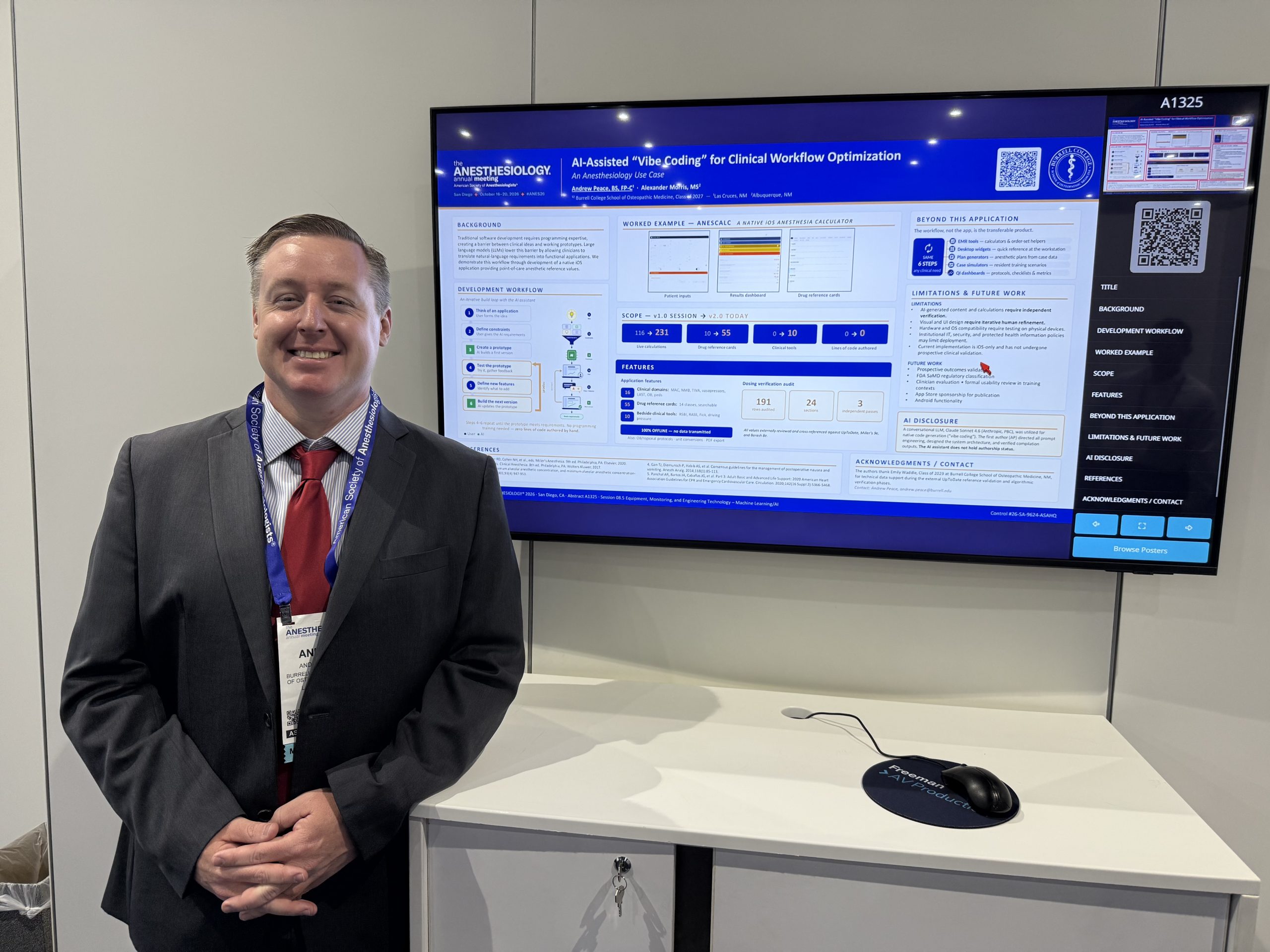
Fourth-year student physician Andrew Peace represented Burrell College of Health Sciences School of Osteopathic Medicine (BCSOM) at the American Society of Anesthesiologists’ annual meeting in San Diego. Alongside classmate and co-author, fourth-year student physician Alexander Morris, Peace presented an ePoster exploring how artificial intelligence can help clinicians develop tools for clinical practice.
Their project, “AI-Assisted Vibe Coding for Clinical Workflow Optimization,” examined whether a clinician without programming experience could build a working clinical tool using plain-language instructions. As a working example, Peace developed AnesCalc, an iOS anesthesia calculator with weight-based drug dosing, dozens of drug references, and bedside clinical tools.
“The people who know exactly what tool would help at the bedside are rarely the ones who can build it,” Peace said. “AI-assisted development starts to close that gap, so a clinician with a clear idea can go from concept to a working prototype in days to weeks, instead of waiting on a development team.”
The team also emphasized the importance of clinical oversight. Before presenting the prototype, they independently verified its dosing information against published literature and corrected errors in the original build.
“AI can put tool-building in clinicians’ hands, but the clinician still owns the accuracy of the information,” Peace said. “AI speeds up the build; it doesn’t replace verification.”
Peace credited Burrell’s medical education with giving him the clinical knowledge to evaluate the application and question information that needed further review. He also said the college’s support for student research gave him and Morris the opportunity to develop their idea and present their findings at a national meeting.
Their project explores how AI-assisted development could give clinicians a more direct role in creating the tools they use in practice, while keeping clinical knowledge and oversight at the center of the process.