Year 3 Burrell College Clinical Rotations & Regional Academic Center
Year 3 Burrell Regional Academic Centers
Burrell College Clinical Education
Burrell College of Health Sciences School of Osteopathic Medicine (BCSOM) has developed a structured clinical education network that includes hospitals, medical centers, Federally Qualified Health Centers, community-based clinics, and practicing physicians who serve as clinical faculty.
This network extends across New Mexico, Texas, Arizona, Florida, and New York and supports a comprehensive selection of generalist and specialty clinical clerkship experiences for third-year medical students. It also provides infrastructure that supports the continued development of Graduate Medical Education programs.
Burrell’s multi-state clinical education network is an intentional part of the College’s regional training model. Students are not assigned to isolated or unaffiliated rotation sites. Instead, they train through established Regional Academic Centers (RAC) that bring together healthcare organizations, clinical faculty, physicians, and community-based providers within defined geographic regions.
Each Regional Academic Center is designed to provide third-year students with:
- Structured clinical clerkship experiences
- Supervision and instruction from clinical faculty and physician preceptors
- Exposure to hospitals, medical centers, community clinics, and physician practices
- Experience with diverse patient populations and healthcare needs
- Opportunities to learn in medically underserved and rapidly growing communities
- Continued academic and clinical education support from the College
This regional approach allows students to experience different healthcare environments while completing Burrell’s established third-year clinical curriculum. Training across hospital and community-based settings helps students strengthen their clinical judgment, communication skills, adaptability, and ability to provide patient-centered care.
Supporting Graduate Medical Education (GME) Development
Burrell College of Osteopathic Medicine has facilitated the ongoing development of new Graduate Medical Education residency programs in family medicine, internal medicine, orthopedic surgery, and osteopathic neuromusculoskeletal medicine.
Additional GME programs are under development in regions where Burrell maintains educational and healthcare partnerships. The College also works directly with established GME programs, helping students become familiar with healthcare systems and communities where they may later pursue residency training.
These relationships help strengthen the pathway from undergraduate medical education to residency training while supporting the development of physicians for the communities and regions Burrell serves.
Regional Academic Center Locations
Burrell has ten Regional Academic Centers for third-year clinical rotations:
- Albuquerque, New Mexico
- Eastern New Mexico
- El Paso, Texas
- Las Cruces, New Mexico
- Tucson, Arizona
- Space Coast, Florida
- Four Corners, New Mexico
- Southwest Florida
- Palm Beach, Florida
- Brooklyn, New York
Each Regional Academic Center is part of Burrell’s organized clinical education network. These centers connect third-year students with hospitals, medical centers, clinics, clinical faculty, and physician preceptors selected to support the College’s clinical curriculum.
The geographic range of this network should not be interpreted as a collection of disconnected clinical sites. Burrell operates campus locations in Las Cruces, New Mexico, and Melbourne, Florida, while its Regional Academic Centers extend the College’s clinical education model into communities across the Southwest, Florida, and New York.
Through these established regional partnerships, students can encounter a broad range of clinical conditions, patient populations, healthcare systems, and community needs.
Core Clinical Teaching Sites
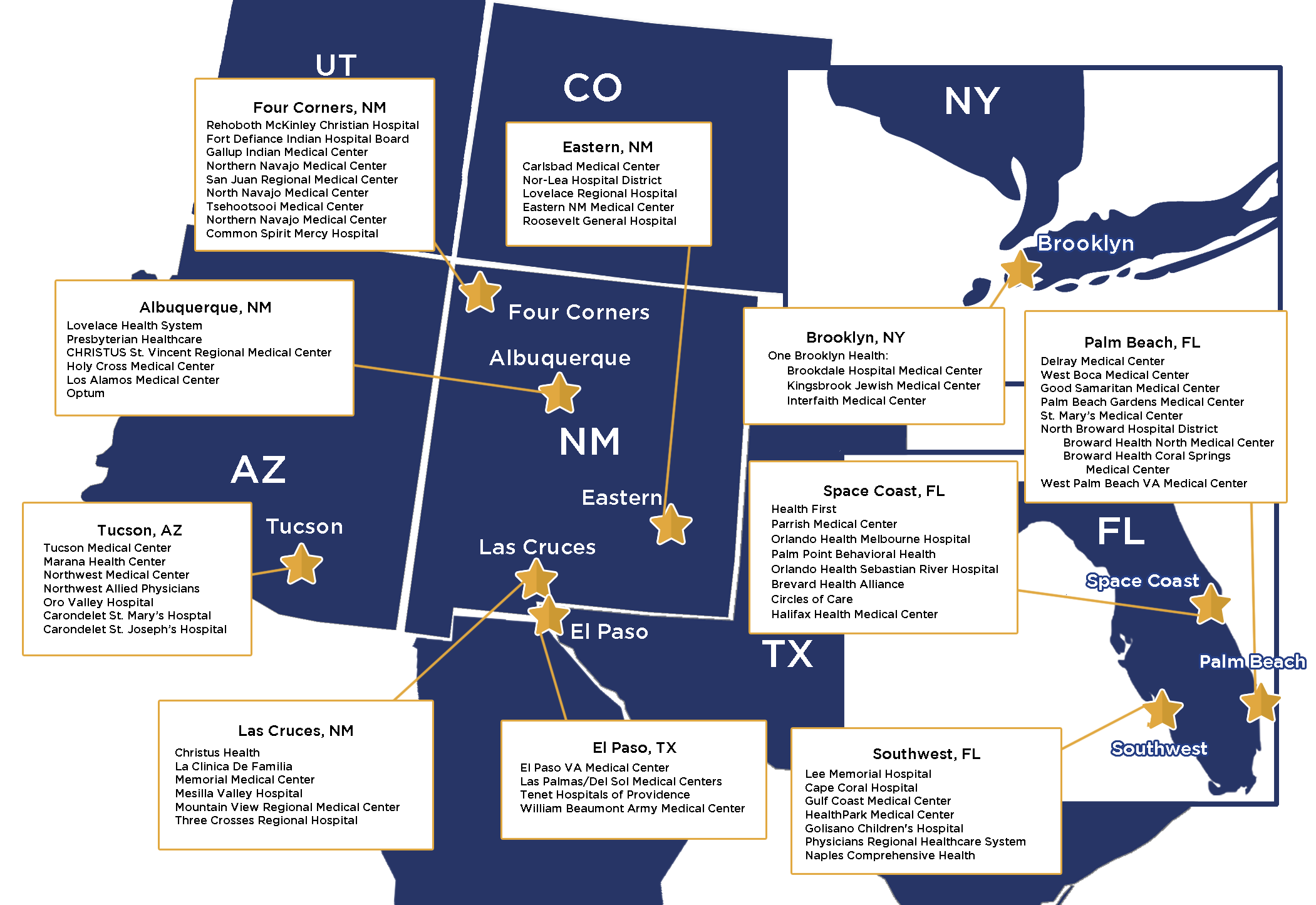
Click on Map to Enlarge
El Paso Regional Academic Center Eligibility
In accordance with applicable regulations, the El Paso, Texas, Regional Academic Center has a capacity limit. At least 90% of students assigned to the El Paso Regional Academic Center must be residents of Texas or Doña Ana County, New Mexico, as identified on their AACOMAS applications.
An Immersive Third-Year Clinical Experience
Within each Regional Academic Center, third-year students experience clinical immersion in medical centers combined with integrated learning experiences in community care clinics and other healthcare settings.
This combination allows students to learn how care is delivered across different environments, from hospital-based services to community and physician-led care. The variety of settings provides an excellent and challenging environment for clerkship training while helping students develop the knowledge, clinical skills, professionalism, and adaptability required for residency and medical practice.
Primary Teaching Hospitals, Medical Centers, and Clinics
The healthcare organizations listed below are collaborative clinical education partners with Burrell College of Health Sciences School of Osteopathic Medicine. There are ten main Regional Academic Centers (RACs) for third-and-fourth year rotations, including: 1) Albuquerque, NM 2) Eastern NM 3) El Paso, TX 4) Las Cruces, NM 5) Tucson, AZ 6) Space Coast, FL 7) Four Corners, NM 8) Southwest, FL and 9) Palm Beach, FL. Per regulation, the El Paso, TX RAC has a capacity limit and at least 90% of students assigned to the El Paso, TX RAC must be residents of Texas or Dona Ana County (NM) as identified on the AACOMAS application. In each RAC, the College’s students will experience immersion in both medical centers and integrating experiences within community care clinics. It is this type of immersion that will provide an excellent environment for clerkship training.
| CORE ROTATION AFFILLIATES | RAC |
|---|---|
| 377th Medical Group | Albuquerque |
| After Hours Pediatrics | Albuquerque |
| American Physician Partners | Albuquerque |
| Aspen Medical Center | Albuquerque |
| Children’s Clinic PA | Albuquerque |
| Duke City Primary Care | Albuquerque |
| El Centro Family Health (FQHC) | Albuquerque |
| Eye Associates of New Mexico | Albuquerque |
| First Choice Community Healthcare (FQHC) | Albuquerque |
| New Mexico Oncology Hematology Consultants, Ltd | Albuquerque |
| Optum Inc | Albuquerque |
| Presbyterian Medical Services (FQHC) | Albuquerque |
| Pueblo of Isleta Health Clinic | Albuquerque |
| Renal Medicine Associates, LTD | Albuquerque |
| Rural Surgical Associates | Albuquerque |
| Southwest Care Center | Albuquerque |
| Southwest Gastroenterology Associates | Albuquerque |
| Southwest Integrative Health Center | Albuquerque |
| Sunrise Clinics | Albuquerque |
| Western Dermatology Consultants | Albuquerque |
| Women’s Specialists of New Mexico, Ltd. | Albuquerque |
| Albuquerque Area Indian Health Service | Albuquerque |
| Christus St. Vincent Hospital | Albuquerque |
| Guadalupe County Hospital | Albuquerque |
| Holy Cross Medical Center | Albuquerque |
| Los Alamos Medical Center | Albuquerque |
| Lovelace Health System | Albuquerque |
| New Mexico Surgery Center Multispecialty | Albuquerque |
| New Mexico Veteran Affairs Health Care System | Albuquerque |
| Presbyterian Healthcare Services | Albuquerque |
| Presbyterian Rust Medical Center | Albuquerque |
| San Miguel Hospital Corporation dba Alta Vista Regional Hospital | Albuquerque |
| Sunrise Medical Group, PC | Albuquerque |
| La Casa Family Health Center | Eastern NM |
| Artesia General Hospital | Eastern NM |
| Carlsbad Medical Center, LLC | Eastern NM |
| Covenant Health System | Eastern NM |
| Nor-Lea Hospital District | Eastern NM |
| Roosevelt General Hospital | Eastern NM |
| Eastern NM Medical Center | Eastern NM |
| American Physician Partners – Hospital Medicine | Eastern NM |
| NES Healthcare- Hospitalist Group | Eastern NM |
| Sound Physicians | Eastern NM |
| BHS Physicians Network, Inc. | El Paso |
| Centro de Salud Familiar La Fe (FQHC) | El Paso |
| Southwest Eye Institute/American Vision Partners | El Paso |
| Southwest Viral Med | El Paso |
| TopCare Medical Group, Inc | El Paso |
| Village Practice Management | El Paso |
| El Paso Surgery Centers | El Paso |
| El Paso VA Heatlh Care System | El Paso |
| HCA Las Palmas Del Sol Healthcare System | El Paso |
| Kindred Hospital | El Paso |
| PAM Health Rehabilitation Hospital of El Paso | El Paso |
| Peak Behavioral Health Services | El Paso |
| The Hospitals of Providence Healthcare System | El Paso |
| West El Paso Surgery Center, LLC | El Paso |
| William Beaumont Army Medical Center | El Paso |
| Envision Health Care | El Paso |
| Four Corners Ambulatory Surgery Center | Four Corners |
| High Desert Nephrology | Four Corners |
| Pinon Family Practice PC | Four Corners |
| Cibola General Hospital Inc | Four Corners |
| Fort Defiance Indian Hospital | Four Corners |
| Navajo Area Indian Health Service | Four Corners |
| Rehoboth McKinley Christian Health Care Services | Four Corners |
| San Juan Regional Medical Center | Four Corners |
| Ben Archer Health Center (FQHC) | Las Cruces |
| Full Bloom Pediatrics | Las Cruces |
| La Clinica de Familia (FQHC) | Las Cruces |
| Las Cruces Physician Practices | Las Cruces |
| Mesilla Valley Hospice | Las Cruces |
| The Surgery Center of Las Cruces | Las Cruces |
| Amador Health Center | Las Cruces |
| Gerald Champion Regional Medical Center | Las Cruces |
| Memorial Medical Center | Las Cruces |
| Mesilla Valley Hospital | Las Cruces |
| MountainView Regional Medical Center | Las Cruces |
| Rehabilitation Hospital of Southern New Mexico | Las Cruces |
| Three Crosses Regional Hospital | Las Cruces |
| American Oncology Partners, P.A. & American Oncology Network, LLC | Southwest FL |
| Lee Memorial Health System (Lee Health) | Southwest FL |
| Naples Community Hospital | Southwest FL |
| Physicians Regional Health System (Naples) | Southwest FL |
| Sarasota Memorial Healthcare Services | Southwest FL |
| Advanced Surgical Care of Viera | Space Coast FL |
| Brevard Health Alliance (FQHC) | Space Coast FL |
| Central Florida Spine & Pain | Space Coast FL |
| Intracoastal Surgery Center | Space Coast FL |
| Merritt Island Surgery Center | Space Coast FL |
| Space Coast Health Centers Inc. | Space Coast FL |
| Treasure Coast Community Health | Space Coast FL |
| Melbourne Emergency Group | Space Coast FL |
| Rockledge Emergency Group | Space Coast FL |
| Circles of Care, Inc. | Space Coast FL |
| Department of Veterans Affairs Orlando | Space Coast FL |
| Devereux Advanced Behavioral Health | Space Coast FL |
| Health First Hospital System and Phycian Group | Space Coast FL |
| Palm Point Behavioral Health | Space Coast FL |
| Rockledge Physicians Services | Space Coast FL |
| Steward Melbourne Regional Medical Center | Space Coast FL |
| Steward Rockledge Regional Medical Center | Space Coast FL |
| Steward Sebastian River Medical Center | Space Coast FL |
| Comprehensive Hospitalists of Florida | Space Coast FL |
| Arizona Community Physicians | Tucson |
| Carbon Health Medical Group, Inc | Tucson |
| Collaborative Care Services, Inc. (“Optum”) | Tucson |
| Desert Sky Spine and Sports Medicine | Tucson |
| Genesis Ob/Gyn | Tucson |
| Marana Health Center (FQHC) | Tucson |
| Pima Heart Physicians, P.C. | Tucson |
| Camp Lowell Surgery Center | Tucson |
| Carondolet Health System – St. Joe’s Hospital | Tucson |
| Carondolet Health System – St. Mary’s Hospital | Tucson |
| Childrens Medical Center of Tucson | Tucson |
| Cobre Valley Regional Medical Center | Tucson |
| Mt. Graham Regional Medical Center Inc. | Tucson |
| Northwest Hospital System | Tucson |
| Oro Valley Surgical | Tucson |
| The Phoenix Area Indian Health Service | Tucson |
| Tuscon Medical Center (TMC) | Tucson |
| Arizona Inpatient Medicine Associates | Tucson |
| CORE ROTATION AFFILLIATES | RAC |
|---|---|
| 377th Medical Group | Albuquerque |
| After Hours Pediatrics | Albuquerque |
| American Physician Partners | Albuquerque |
| Aspen Medical Center | Albuquerque |
| Children’s Clinic PA | Albuquerque |
| Duke City Primary Care | Albuquerque |
| El Centro Family Health (FQHC) | Albuquerque |
| Eye Associates of New Mexico | Albuquerque |
| First Choice Community Healthcare (FQHC) | Albuquerque |
| New Mexico Oncology Hematology Consultants, Ltd | Albuquerque |
| Optum Inc | Albuquerque |
| Presbyterian Medical Services (FQHC) | Albuquerque |
| Pueblo of Isleta Health Clinic | Albuquerque |
| Renal Medicine Associates, LTD | Albuquerque |
| Rural Surgical Associates | Albuquerque |
| Southwest Care Center | Albuquerque |
| Southwest Gastroenterology Associates | Albuquerque |
| Southwest Integrative Health Center | Albuquerque |
| Sunrise Clinics | Albuquerque |
| Western Dermatology Consultants | Albuquerque |
| Women’s Specialists of New Mexico, Ltd. | Albuquerque |
| Albuquerque Area Indian Health Service | Albuquerque |
| Christus St. Vincent Hospital | Albuquerque |
| Guadalupe County Hospital | Albuquerque |
| Holy Cross Medical Center | Albuquerque |
| Los Alamos Medical Center | Albuquerque |
| Lovelace Health System | Albuquerque |
| New Mexico Surgery Center Multispecialty | Albuquerque |
| New Mexico Veteran Affairs Health Care System | Albuquerque |
| Presbyterian Healthcare Services | Albuquerque |
| Presbyterian Rust Medical Center | Albuquerque |
| San Miguel Hospital Corporation dba Alta Vista Regional Hospital | Albuquerque |
| Sunrise Medical Group, PC | Albuquerque |
| CORE ROTATION AFFILLIATES | RAC |
|---|---|
| La Casa Family Health Center | Eastern NM |
| Artesia General Hospital | Eastern NM |
| Carlsbad Medical Center, LLC | Eastern NM |
| Covenant Health System | Eastern NM |
| Nor-Lea Hospital District | Eastern NM |
| Roosevelt General Hospital | Eastern NM |
| Eastern NM Medical Center | Eastern NM |
| American Physician Partners – Hospital Medicine | Eastern NM |
| NES Healthcare- Hospitalist Group | Eastern NM |
| Sound Physicians | Eastern NM |
| CORE ROTATION AFFILLIATES | RAC |
|---|---|
| BHS Physicians Network, Inc. | El Paso |
| Centro de Salud Familiar La Fe (FQHC) | El Paso |
| Southwest Eye Institute/American Vision Partners | El Paso |
| Southwest Viral Med | El Paso |
| TopCare Medical Group, Inc | El Paso |
| Village Practice Management | El Paso |
| El Paso Surgery Centers | El Paso |
| El Paso VA Heatlh Care System | El Paso |
| HCA Las Palmas Del Sol Healthcare System | El Paso |
| Kindred Hospital | El Paso |
| PAM Health Rehabilitation Hospital of El Paso | El Paso |
| Peak Behavioral Health Services | El Paso |
| The Hospitals of Providence Healthcare System | El Paso |
| West El Paso Surgery Center, LLC | El Paso |
| William Beaumont Army Medical Center | El Paso |
| Envision Health Care | El Paso |
| CORE ROTATION AFFILLIATES | RAC |
|---|---|
| Four Corners Ambulatory Surgery Center | Four Corners |
| High Desert Nephrology | Four Corners |
| Pinon Family Practice PC | Four Corners |
| Cibola General Hospital Inc | Four Corners |
| Fort Defiance Indian Hospital | Four Corners |
| Navajo Area Indian Health Service | Four Corners |
| Rehoboth McKinley Christian Health Care Services | Four Corners |
| San Juan Regional Medical Center | Four Corners |
| CORE ROTATION AFFILLIATES | RAC |
|---|---|
| Ben Archer Health Center (FQHC) | Las Cruces |
| Full Bloom Pediatrics | Las Cruces |
| La Clinica de Familia (FQHC) | Las Cruces |
| Las Cruces Physician Practices | Las Cruces |
| Mesilla Valley Hospice | Las Cruces |
| The Surgery Center of Las Cruces | Las Cruces |
| Amador Health Center | Las Cruces |
| Gerald Champion Regional Medical Center | Las Cruces |
| Memorial Medical Center | Las Cruces |
| Mesilla Valley Hospital | Las Cruces |
| MountainView Regional Medical Center | Las Cruces |
| Rehabilitation Hospital of Southern New Mexico | Las Cruces |
| Three Crosses Regional Hospital | Las Cruces |
| CORE ROTATION AFFILLIATES | RAC |
|---|---|
| Arizona Community Physicians | Tucson |
| Carbon Health Medical Group, Inc | Tucson |
| Collaborative Care Services, Inc. (“Optum”) | Tucson |
| Desert Sky Spine and Sports Medicine | Tucson |
| Genesis Ob/Gyn | Tucson |
| Marana Health Center (FQHC) | Tucson |
| Pima Heart Physicians, P.C. | Tucson |
| Camp Lowell Surgery Center | Tucson |
| Carondolet Health System – St. Joe’s Hospital | Tucson |
| Carondolet Health System – St. Mary’s Hospital | Tucson |
| Childrens Medical Center of Tucson | Tucson |
| Cobre Valley Regional Medical Center | Tucson |
| Mt. Graham Regional Medical Center Inc. | Tucson |
| Northwest Hospital System | Tucson |
| Oro Valley Surgical | Tucson |
| The Phoenix Area Indian Health Service | Tucson |
| Tuscon Medical Center (TMC) | Tucson |
| Arizona Inpatient Medicine Associates | Tucson |
| CORE ROTATION AFFILLIATES | RAC |
|---|---|
| Advanced Surgical Care of Viera | Space Coast FL |
| Brevard Health Alliance (FQHC) | Space Coast FL |
| Central Florida Spine & Pain | Space Coast FL |
| Intracoastal Surgery Center | Space Coast FL |
| Merritt Island Surgery Center | Space Coast FL |
| Space Coast Health Centers Inc. | Space Coast FL |
| Treasure Coast Community Health | Space Coast FL |
| Melbourne Emergency Group | Space Coast FL |
| Rockledge Emergency Group | Space Coast FL |
| Circles of Care, Inc. | Space Coast FL |
| Department of Veterans Affairs Orlando | Space Coast FL |
| Devereux Advanced Behavioral Health | Space Coast FL |
| Health First Hospital System and Phycian Group | Space Coast FL |
| Palm Point Behavioral Health | Space Coast FL |
| Rockledge Physicians Services | Space Coast FL |
| Steward Melbourne Regional Medical Center | Space Coast FL |
| Steward Rockledge Regional Medical Center | Space Coast FL |
| Steward Sebastian River Medical Center | Space Coast FL |
| Comprehensive Hospitalists of Florida | Space Coast FL |
Click below to learn more about the Regional Academic Centers:
Academics
Frequently Asked Questions
Are Burrell students sent to distant clinical sites because local rotations are unavailable?
Burrell’s clinical education program is intentionally organized around a network of Regional Academic Centers rather than a single teaching hospital. The College has two campuses—in Las Cruces, New Mexico, and Melbourne, Florida—and clinical education partnerships across New Mexico, Texas, Arizona, Florida, and New York. Each Regional Academic Center is part of a structured network of hospitals, medical centers, clinics, physicians, and preceptors selected to support the College’s clinical curriculum.
Does training outside New Mexico mean students are disconnected from Burrell?
No. Students training through a Burrell Regional Academic Center remain part of Burrell’s academic program and continue to receive institutional resources and clinical education support. Regional training allows students to learn within different healthcare systems while progressing through Burrell’s established curriculum.
Is clinical training at a Regional Academic Center comparable to training at an academic medical center?
Clinical education can be delivered effectively in several settings, including hospitals, medical centers, community health centers, clinics, and physician practices. Burrell’s model gives students supervised, hands-on experience across these environments, allowing them to encounter diverse patients, conditions, specialties, and approaches to care.